
In the high-stakes environment of the Manchester Derby, headlines naturally gravitate toward the final scoreline and the goalscorers. However, to view the fixture solely through the lens of statistics is to miss the broader strategic battle. The presence of Manchester City’s number nine changes the fundamental geometry of the pitch. This analysis explores the Erling Haaland tactical impact vs Man Utd, dissecting not just his finishing, but how his movement, physical gravity, and mental resilience force Manchester United into defensive compromises. In the context of modern football in 2026, where specialized roles define elite systems, Haaland’s influence on this specific rivalry serves as a blueprint for understanding the evolution of the classic striker.
Context & Situation Analysis: The Derby Dynamic
The Manchester Derby has evolved significantly over the last decade, transitioning from a clash of passion to a collision of distinct tactical ideologies. When discussing the Erling Haaland tactical impact vs Man Utd, it is essential to understand the unique context this fixture provides. Unlike standard Premier League fixtures where City faces deep, passive low blocks, United often approaches this game with a hybrid strategy-attempting to remain compact while looking for rapid transitions.
For Haaland, this creates a specific set of challenges and opportunities. The narrative entering these matches is rarely about whether he will get chances, but rather how effectively United’s center-back pairing can isolate him from City’s supply line. The pressure is immense; in a game where margins are razor-thin, Haaland is expected to operate with minimal touches yet deliver maximum output.
The situation usually dictates that United must over-commit resources to neutralize him. This is the first layer of his impact: distraction. Even before a ball is kicked, the defensive game plan of the opposition is heavily skewed toward containing one individual. This psychological and tactical “tax” placed on the opponent is a crucial element of the analysis, setting the stage for how the 90 minutes unfold.
Tactical Role in the Current System
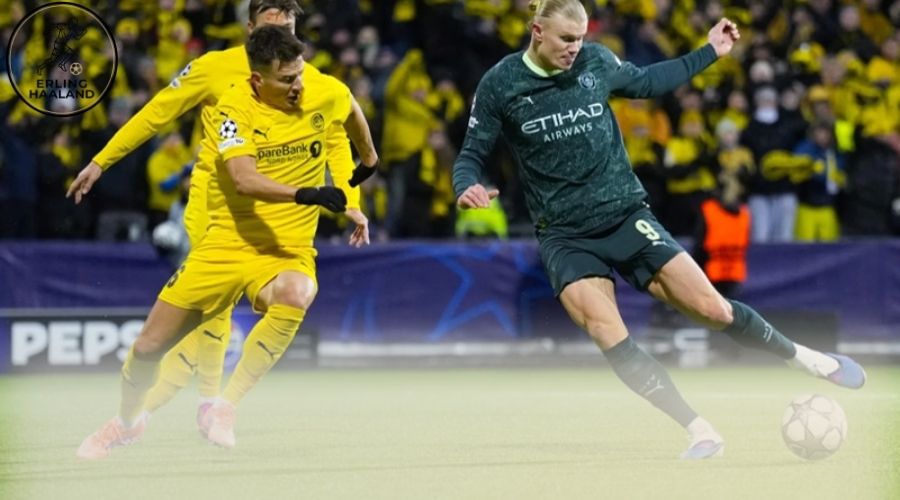
Haaland’s role in Pep Guardiola’s system has never been about total football participation; it is about total spatial domination. Against a team like Manchester United, this role becomes hyper-specialized.
Pinning the Central Defenders
The core of the Erling Haaland tactical impact vs Man Utd lies in his ability to pin the opposition’s center-backs. By positioning himself on the shoulder of the last defender, often drifting into the blind side of the deeper center-back, he forces the United defensive line to drop five to ten yards deeper than they would comfortably prefer.
This creates a “vertical stretch” on the pitch. When the defensive line drops deep to prevent Haaland from running in behind, the space between United’s defense and midfield expands. This creates the “pocket” where players like Phil Foden or Kevin De Bruyne thrive. Haaland does not need to touch the ball to facilitate this; his threat in behind is what manufactures the space for others.
Manipulation of the Half-Spaces
While traditional target men stay central, Haaland’s movement often involves subtle arcs toward the back post or diagonal runs across the face of the defense. In the Derby, this is critical because it disrupts the communication between United’s full-backs and center-backs. If a center-back follows Haaland wide, the middle opens up for a trailing runner (an 8 or a winger cutting inside). If they pass him off to a full-back, a vivid physical mismatch is created.
This decision-making crisis he imposes on the defense is constant. He forces defenders to choose between maintaining their shape or tracking his run, and in the split second of hesitation, City’s system is designed to punish the error.
Mentality, Leadership & Decision Pressure
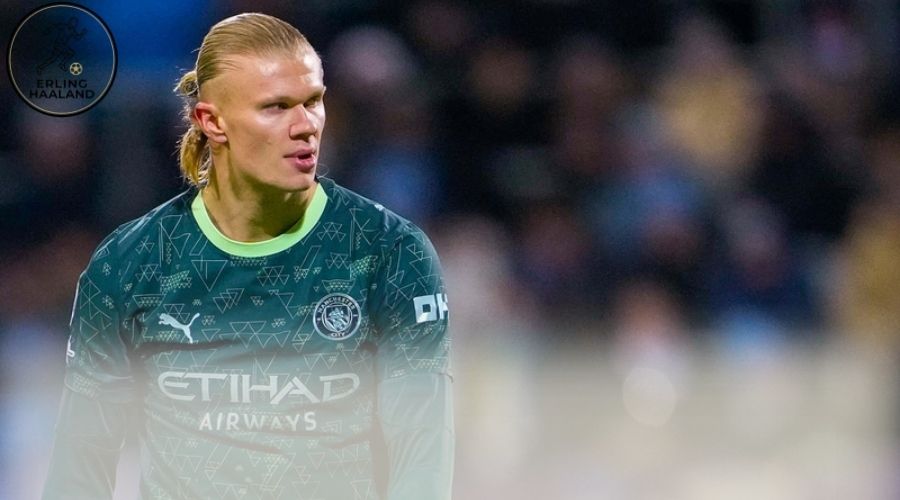
Modern leadership in football is not always vocal; often, it is behavioral. One of the most underrated aspects of the Erling Haaland tactical impact vs Man Utd is his patience and emotional regulation.
In high-voltage games like the Derby, frustration is a common enemy for strikers. Supply lines can be cut, and touches can be scarce. However, Haaland’s mentality is characterized by an “Ice Man” demeanor. He accepts periods of isolation as part of the job description. This patience is a tactical weapon. By refusing to drop deep in search of the ball-a trap many strikers fall into-he ensures that City maintains its vertical threat at all times.
If he were to drop into midfield to get touches, he would compress the space City is trying to expand. His discipline to stay high, effectively waiting for the single moment of service, puts immense psychological pressure on United’s defenders. They know they cannot switch off for a single second. This mental attrition wears down the opposition over 90 minutes, leading to fatigue-induced errors late in the game. It is a form of leadership that prioritizes the team’s structural integrity over individual involvement.
Short-Term Impact on Match States
The analysis of Erling Haaland tactical impact vs Man Utd must also consider game states. The flow of a Derby is rarely linear, and Haaland’s utility shifts depending on the scoreline.
Breaking the Deadlock
At 0-0, Haaland operates as a battering ram. His physical duels with defenders are designed to establish dominance. He offers City a “get out of jail” option. If United’s press is effective and City cannot play through the lines, Ederson has the option to go long directly to Haaland. This bypasses the midfield battle entirely and forces United into an uncomfortable physical contest in their own third.
Exploiting the Chase
If City takes the lead, Haaland becomes arguably the most dangerous counter-attacking weapon in world football. As United is forced to push their defensive line higher to chase an equalizer, the space behind them-previously compressed-becomes a vast expanse. Haaland’s top-end speed and stride length allow him to exploit these high lines devastatingly. This forces United into a dilemma: chase the game and risk a Haaland break, or stay conservative and accept defeat. His presence essentially checkmates the opponent’s ability to chase a game aggressively.
Long-Term Implications for Club & Career
Looking beyond a single fixture, the recurring nature of the Erling Haaland tactical impact vs Man Utd offers insight into the long-term trajectory of his career and Manchester City’s squad planning.
For the club, the reliance on a specialist striker in big games signals a permanent shift away from the “False 9” era. The strategy is now built around maximizing the efficiency of a single terminal point. This requires a recruitment strategy focused on ball-carriers and high-volume chance creators who are comfortable serving a focal point rather than rotating into that space themselves.
For Haaland, his career trajectory is defined by this efficiency. He is moving toward a career model that prioritizes longevity and explosive moments over general workload. By sparing his body from the grinding work of pressing and link-up play, he preserves his explosiveness for the decisive actions. This suggests that as he ages, his game will become even more distilled, focusing purely on the mechanics of goal-scoring and spatial manipulation.
What This Tells Us About Modern Football
The dynamics discussed in this Erling Haaland tactical impact vs Man Utd analysis are reflective of broader trends in 2026 football. We are entering an era of “Hyper-Specialization.”
The period of universalists-players who could do everything-is being complemented by the return of specialists who do one thing at an elite level. Data analytics has driven this shift. Clubs have realized that “Expected Goals” (xG) accumulation is most stable when funneled through a player whose physical and technical profile is optimized for conversion.
Haaland represents the pinnacle of this data-driven approach. He is not judged by pass completion or distance covered, but by his impact on the team’s “Probability of Scoring.” His role in the Derby highlights that modern football is less about aesthetic fluidity and more about ruthless efficiency. The ability to control space without the ball is now valued as highly as the ability to dribble with it.
Conclusion: Reading Beyond the Result
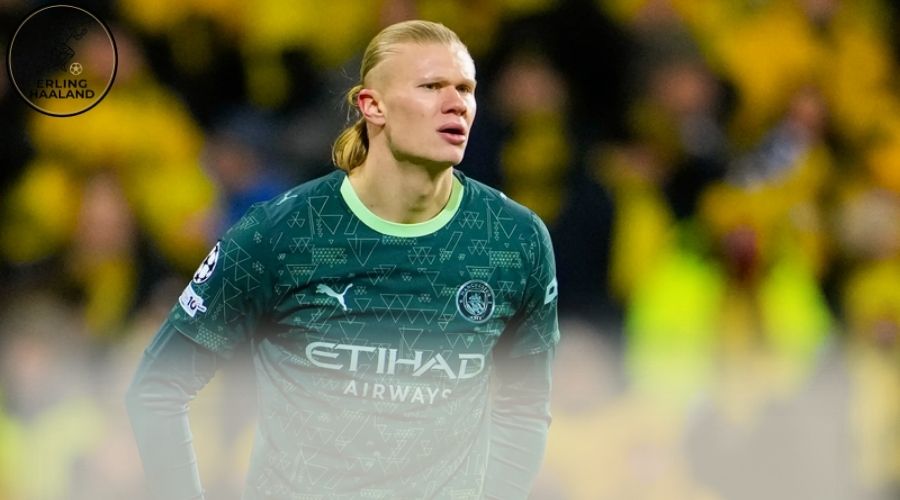
Ultimately, the headlines following a Manchester Derby will always belong to the goalscorers, but the analysis must go deeper. The Erling Haaland tactical impact vs Man Utd is not solely defined by the ball hitting the net. It is defined by the defensive lines he distorts, the midfield pockets he creates for teammates, and the psychological fear he instills in the opposition’s backline.
He represents a tactical constant in a chaotic fixture. Whether he touches the ball five times or fifty, his function remains the same: to act as the anchor around which the rest of the attack pivots. As football continues to evolve into a game of structures and transitions, understanding these off-ball mechanics becomes essential for any serious observer.
